
You're involved in a serious car accident. You're shaken up, but luckily you don't sustain any serious injuries. But the person who caused the accident is seriously injured. You arrive at his car and immediately see a deep gash in his right forearm. Blood spurts out, and the victim's face becomes increasingly pale. Do you know what to do in the event of a catastrophic hemorrhage?
The Dutch military has transitioned from the BATLS C-ABCDE protocol to the Tactical Combat Casualty Care (TCCC) MARCH protocol. Both protocols provide a medical step-by-step plan for saving lives in emergency situations:
M – Massive Bleeding – Catastrophic bleeding
A – Airway – Airway
R – Respiration – Breathing
C – Circulation – Circulation
H – Hypothermia – Hypothermia
In both the C-ABCDE and MARCH protocols, resolving a life-threatening hemorrhage is the first priority. This is the leading cause of death in most cases.
Did you know that a victim can bleed to death within minutes? If you see severe bleeding in a car accident victim, it's important to know exactly what to do to save their life. Military personnel, such as first responders and medics, are uniquely trained to respond proactively in these types of emergencies. Therefore, this article briefly explains what you can learn from this to save another person's life.
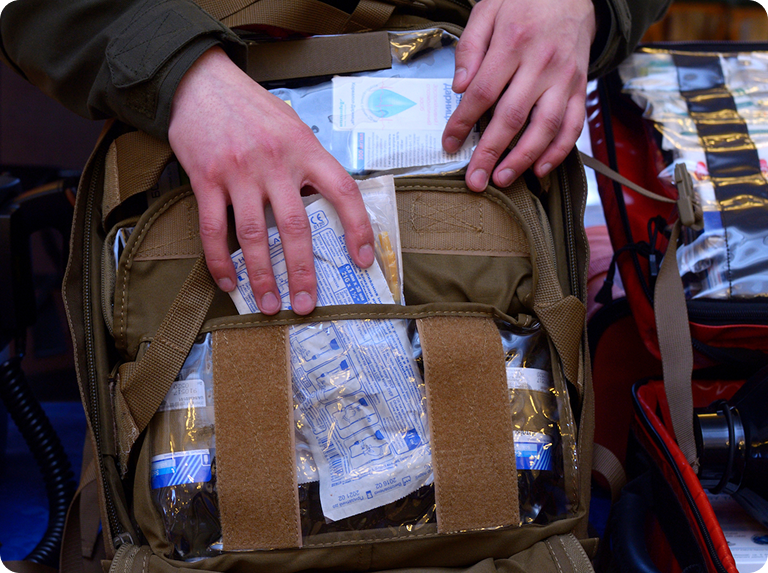
All military personnel receive Self-Help Comrades Assistance (ZHKH) training during their initial training. This provides the foundation for helping yourself or your comrade with injuries ranging from life-threatening situations to other injuries. You can also further develop your skills as a first responder. Within the Dutch Defence Force, the following levels are designated:
Wound care worker
Injury care provider
Medic
General Military Nurse (AMV)
Different levels of medical care exist, and they all start with the same protocol for catastrophic bleeding. Therefore, it's important to understand the procedures and theory involved.
For now we will only discuss the M, what is it, what can you do about it and what can you treat it with.
When do we speak of a Massive Bleeding?
when we lose more than 1 times our total blood volume in 24 hours
if the victim loses more than 50% of the total blood volume in 3 hours
if your victim loses more than 150 ml of blood in 1 minute
What can you do about it?
Act quickly and correctly according to the MARCH protocol
What do you treat Massive Hemorrhage with?
By means of a tourniquet also called CAT
By means of a wound packing with a hemostatic bandage
Different levels of medical care exist, and they all start with the same protocol for catastrophic bleeding. Therefore, it's important to understand the procedures and theory involved.
As a first responder or combat medic, you want to pack your medical equipment so you're always well-prepared for a potential deployment. This significantly increases a casualty's chance of survival. A tip to speed up your response is to remove the outer packaging, if necessary, and ensure your CAT is ready for quick deployment by removing it from the plastic. This way, it's ready for immediate use.
Your Individual First Aid Kit (IFAK) is, of course, packed according to the described standard. Essential items included in the IFAK include:
1. The carrying bag / Medic combat pouch / Individual First Aid Kit (IFAK)
2. Gloves
3. Pair of scissors
4. Pen
5. Tourniquet
6. Combat Gauze – hemostatic bandage
7. Emergency bandage / Israeli bandage
8. Chest Seal
9. Aluminum blanket
%20(1)-3.png?width=1440&height=800&name=Hero%20Section%20(1)%20(1)-3.png)
The 7 functions of combat refer to the framework used by the military to plan and execute operations. These functions plays a crucial role in achieving military objectives by ensuring the physical movement of troops and equipment, gathering and analyzing intelligence.
READ MORE
TCCC originated in the United States. Since 2005, military personnel have been trained here to apply the TCCC in enemy territory to increase the chance of a casualty's survival.
READ MORE
The 5-paragraph model (also called the five-paragraph order), often used during the issuing of orders, can be used anywhere and by anyone. Whether you work in the Ministry of Defence or at your local restaurant, this model allows you to give your unit or employees a clear briefing on the agenda.
READ MORE


