
"A frequently asked question during our training sessions often concerns all the different jargon that exists." Two that stand out are Tactical Combat Casualty Care (TCCC) and Tactical Emergency Casualty Care (TECC). In this article, we'll explore the differences and similarities between the two disciplines, aiming to clarify them once and for all.
TCCC originated in the United States. Since 2005, military personnel have been trained here to apply the TCCC in enemy territory to increase the chance of a casualty's survival. To provide the best medical care to military personnel on missions, the US Army established the Committee on Tactical Combat Casualty Care (CoTCCC) (footnote 1). This committee consists of 42 voting members, representing the best physicians and military personnel from the Army, Navy, Air Force , and Marine Corps . These experts are selected for their extensive experience and knowledge. They utilize various working groups and partner organizations to conduct their scientific research. In this way, they guide new developments within TCCC. In short, a reliable and professional source of information for everyone to learn from.
Europe is eager to utilize these lessons from America. TCCC is also increasingly being embraced within the Dutch Defense Department. The professional context of a soldier differs from that of a police officer, firefighter, or paramedic, which is one of the reasons TECC was developed. More on this later. However, the medical protocols used by TCCC and TECC to help victims are identical.
Both methods utilize the MARCH protocol. This evidence-based medical protocol, administered by the first responder, increases the victim's chance of survival. This protocol is therefore used in both TCCC and TECC. Before we delve deeper into the similarities between the two methods, let's first take a closer look at what exactly they entail.
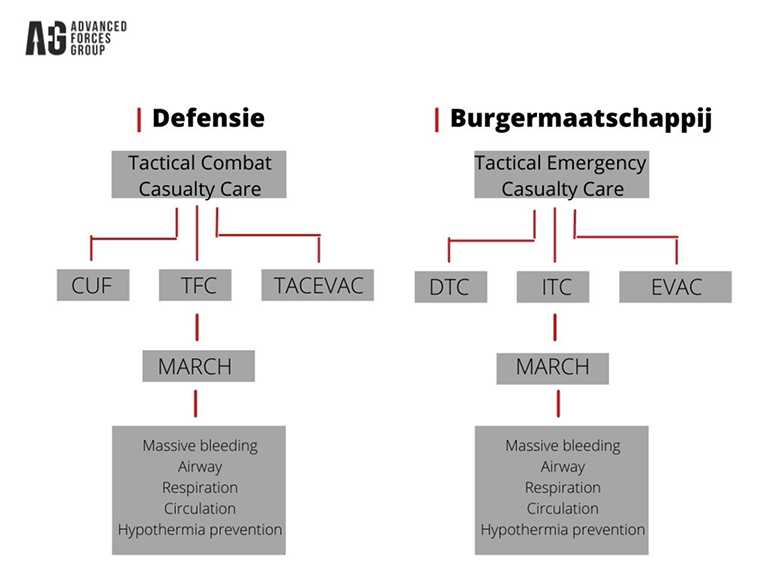
TCCC stands for Tactical Combat Casualty Care and is applied in enemy territory by and for military personnel. This method consists of three different phases, which vary depending on the threat level the military personnel are in. The three different phases covered are (footnote 2):
The minimum care you can provide during an enemy attack. This can be administered by either your buddy or yourself. Because speed is of the essence here, only the tourniquet is typically used. This is a fast and effective way to stop catastrophic limb bleeding.
Care provided in the field, but not during an enemy attack. The MARCH protocol is used here. This MARCH protocol also includes various phases such as Massive Bleeding, Airway, Respiration, Circulation, and Hypothermia prevention. By following all these different phases, it is possible to save a life in the field.
This is the evacuation care provided during movement from the field to a sick station.
TECC stands for Tactical Emergency Casualty Care, which is derived from the TCCC. In this method, the citizen is the primary concern. When a citizen is in a life-threatening situation, the TECC method can be applied. Just like with the TCCC, there are three distinct phases (footnote 3):
First, mitigate the threat, then move the injured person to a safer area. Determine whether the injured person is conscious or not and adjust the next steps accordingly. Stop catastrophic bleeding by applying direct pressure to the wound. Use a tourniquet for this.
This stage occurs when caregivers and patients cannot be harmed further. Like the TCCC, the MARCH protocol is used, plus the letter E, which stands for Everything Else.
Evacuation care is intended to transport the casualty to definitive care. When there are multiple injured people, it's important to determine who should be treated first and therefore transferred. During this phase, it's important to reassess all steps of the MARCH protocol.
Besides the main similarity in applying the MARCH protocol, there are three key differences that explain why the TECC was developed alongside the TCCC (footnote 4) . These differences lie in the terminology used, trauma guidelines, and the focus of TCCC or TECC care.
The TCCC is specifically written for situations occurring in enemy territory. Its starting point is soldiers with certain health conditions who are injured. Military terminology, rules, and behaviors are used. These are not applicable in "daily life."
The trauma guidelines are similar, yet distinct. The TECC focuses more on communication between the various emergency services present and the citizen. Furthermore, the advice provided by the TECC will differ when the citizen is in a life-threatening situation than by the TCCC.
Military personnel are focused on clearing, holding, or capturing territory, with TCCC responding when someone is injured. In civilian settings, it's a rescue operation, which involves TECC. This is where the TCCC and TECC differ most. Now that the differences are clear, it's perhaps even more important to understand the similarity: the MARCH protocol.
Whether you work in the military, police, or fire department, mastering the MARCH protocol can increase a victim's chance of survival in various situations. Even if you're not a certified first responder, this knowledge can make all the difference. Falling down the stairs, getting into a car accident, or experiencing another accident is always unexpected and can happen to anyone.
For further content adjustments, guidelines have been developed for Tactical Combat Casualty Care and Tactical Emergency Casualty Care.
If you have any questions about this article, please feel free to contact us. Or if you have another question you'd like answered, please contact our research team. You can do so at natalie@advancedforcesgroup.com
[1] 19-03-2021, Tactical Combat Casualty care, deployed medicine, https://www.deployedmedicine.com/market/11
[2] 03-19-2021, TCCC Guidelines, Joint Trauma System & Committee on Tactical Combat Casualty Care, https://books.allogy.com/web/tenant/8/books/baa69f13-ac84-4e00-a99d-40e0997d95ca/#idc21999fb-ce53-48e3-8fef-661c70e9554d
[3] 19-03-2021, Tactical Emergency Casualty Care , Committee Tactical Emergency Casualty Care, http://www.c-tecc.org/images/content/TECC_Guidelines_-_JUNE_2015_update.pdf
[4] 2021-03-19, Committee for Tactical Emergency Casualty Care, http://www.c-tecc.org/about/faq
%20(1)-3.png?width=1440&height=800&name=Hero%20Section%20(1)%20(1)-3.png)
The 7 functions of combat refer to the framework used by the military to plan and execute operations. These functions plays a crucial role in achieving military objectives by ensuring the physical movement of troops and equipment, gathering and analyzing intelligence.
READ MORE%20(1)-2.png?width=1440&height=800&name=Hero%20Section%20(1)%20(1)-2.png)
The 5-paragraph model (also called the five-paragraph order), often used during the issuing of orders, can be used anywhere and by anyone. Whether you work in the Ministry of Defence or at your local restaurant, this model allows you to give your unit or employees a clear briefing on the agenda.
READ MORE
The Dutch military has transitioned from the BATLS C-ABCDE protocol to the Tactical Combat Casualty Care (TCCC) MARCH protocol. Both protocols provide a medical step-by-step plan for saving lives in emergency situations:
READ MORE


